
UK Pre-tax and Post-tax Benefits 2024: A Comprehensive Guide
Are you planning your company’s benefit package for this year? If yes, it is imperative to understand the pre-tax and post-tax benefits covered by the contributions before the tax payment and after tax deductions. Now, the question may arise in your mind, “Which Is Better: Pre-tax Benefits or Post-tax Ones?” Well, you will experience positive and negative benefits in both cases.
In today’s guide, we will break down the best ways to construct a tax-advantaged benefit package for your business that optimizes the tax savings so you can attract and retain more and more talent for your organization.
What Are Pre-tax Benefits, and What Are Post-tax Benefits?
Pre-tax benefits are the amount taken from an employee’s salary before the federal and employment income tax deductions. These pre-tax deductions include retirement plan contributions, insurance premiums, transportation benefits, and dependent care programs, which lower the tax liabilities not just for employees but employers as well.
Overall, it cuts down the federal tax pay and reduces taxable earnings on employees’ wages. However, you may not get some tax benefits under federal tax withholding laws. That’s why it is crucial to consult with a top professional tax advisor in Ashford for the best advice before planning the benefit package for your company.
On the other hand, post-tax benefits are the amount coming out of a worker’s income after the tax deduction. However, these deductions do not impact the tax-owed amount and taxable wages as the net pay is reduced in this case, not the gross pay. Due to post-tax benefits, your employees do not need to pay any income tax on these when using them in the future. However, workers and employers may have to pay more for federal and local taxes, employment tax, income tax and payroll tax on post-tax benefit deductions.
See here some examples of pre-tax and post-tax benefits.
Pre-tax Benefits
When constructing your organization’s benefit package, it takes a lot of time to identify the right benefits to provide your workers before the tax deductions so both of you enjoy the tax advantage. Here’s the quick overview you need:
Health Savings Accounts (HSAs) and Medical Expenses
Health savings accounts, also known as tax groups, are funded by both employers and employees. It allows workers to use it for free without paying for any additional tax pay for healthcare needs, like deductibles and copayments. The amount is deducted from employees’ paychecks, which lowers the gross income. Also, there are a few more attractive advantages:
- Interest is free of tax.
- Tax-free withdrawals
- The money can be retained even after leaving the job
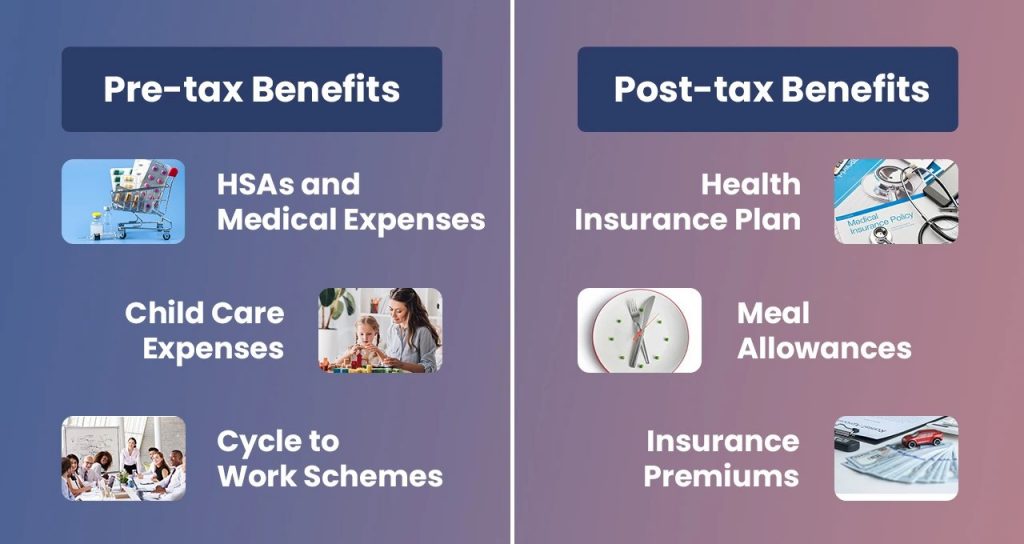
Child Care Expenses
In the workplace, the places allocated to workers’ children are free of income tax and national insurance contributions. Just employees have to meet all the required criteria open to all children of the workers employed at the same location. Also, employers provide childcare vouchers to meet childcare expenses, which are commonly offered through salary sacrifice. If workers are already in a childcare voucher scheme since 4th October 2018, they can keep using this benefit until the offer is provided. Or they can shift to the childcare scheme exempt from tax pay.
Cycle to Work Schemes
As an employer, you can offer your workers the benefit of using a bicycle and safety equipment to cycle between the sites. The funding for the cycle provision comes from the employees’ wages. Also, the workers can buy the bicycle at second-hand value unless the scheme is offered as a hire-purchase agreement when a tax advantage is applied. Make sure the following criteria are met:
- Workers must know that the bikes cannot be sold during the hire period.
- The bicycle cannot be used for leisure for any member of the family or alone.
- This cycle-to-work scheme is open for all workers, including 18s, wishing to join but cannot due to the Consumer Credit rules. There must be provisions for them.
Post-tax Benefits
Now, let’s come to some of the common after-tax benefits that you should include in the benefit package:
Health Insurance Plan
Although health insurance plans are paid out of pre-tax gross income, many workers fill insurance premium payments from the post-tax benefits. In this case, it affects the amount of federal tax payment and the employee’s eligibility for the rest tax benefits. It is ideal to pay the premiums for medical insurance premiums with pre-tax money instead of post-tax amounts. Thus, you can cut down the total taxable income amount.
Meal allowances
It is imperative to take care of your employees’ well-being and health. Being an employer, you can add a meal allowance to the benefit package of your company. You can include it in the post-tax benefits by providing meal vouchers or prepaid cards or increasing the HMRC-approved meal allowance charges.
Insurance premiums
Whether it is a life insurance premium, disability insurance, or health insurance, it is contributed from the after-tax amount. Group-term life insurance premiums are the most common post-tax deduction. Also, many workers can pay insurance premiums with both pre and post-tax contributions for short-term and long-term visibility by leveraging the employer’s medical plan.
In Conclusion
We hope you have a brief idea of the tax-advantaged benefits regarding pre-tax and post-tax in 2024. And, if you need further advice from professionals and are seeking a top tax consultant nearby, count on us! At Tax First Consultants Ltd, we have the best accountants in Ashford to guide you throughout when structuring your company’s benefits package.
For more, call us today!


